How to Find a High-Quality Meme Coin Entry Without Chasing the Pump
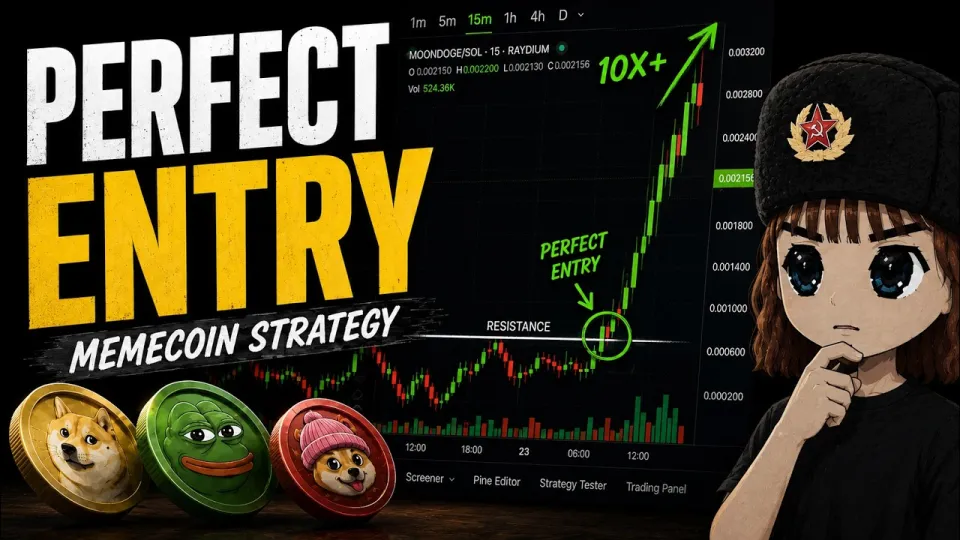
Video: How I Find the PERFECT Entry on Memecoins 📈 (Full Strategy)
Need articles like this for your video? They help promote it on YouTube and Google — order them in the Telegram bot @sat_sit_bot. It writes articles around your video, embeds the video and publishes them on popular niche websites (no ads). Try it free: 50 articles on us.
· based on the channel starwifpump
Key takeaways
- Most meme coin losses come from timing the entry wrong, not from picking the wrong ticker — the same coin can be a good trade or a bad one depending on where you buy.
- A quality entry needs three confirmations: momentum that is still building, a pullback into a defined support level, and a chart structure that has not yet broken down.
- Chasing a vertical green candle destroys risk-to-reward: entering 40–60% above the base turns a normal retrace into a full stop-out.
- Invalidation must be defined before the buy: a lower low, a failed reclaim of support, or fading volume on the bounce are reasons to stay out.
- Exit and profit-taking levels are planned before entry, not after — meme coins can round-trip an entire move in minutes.
A high-quality meme coin entry is not about predicting the next 10x — it is about buying after momentum is confirmed but before the crowd piles in, at a price where your invalidation level is close and clearly defined. In practice that means waiting for a pullback into support, checking that volume and structure still agree, and sizing the position so a normal retrace does not end the trade. The full framework is what the starwifpump breakdown walks through, and the fastest way to follow the tooling discussed there is the Plasma Telegram early-access link.
Why the entry matters more than the coin
Most meme coin traders do not lose because they picked a bad token; they lose because they bought the top of a move that was already exhausting. A memecoin chart is a sentiment chart — it goes vertical on attention and collapses when attention rotates — so the same ticker can be a great trade at one price and a terrible one 30% higher. Position entry determines the entire risk-to-reward ratio of the trade: buying near a defended support level with a tight invalidation gives you a small defined loss and a large potential upside, while buying a green candle in the middle of a parabolic leg gives you the opposite. That asymmetry, not the narrative, is what compounds over many trades.
The three confirmations to look for before buying
A repeatable entry checklist beats intuition, and the useful version has three parts that must agree.
- Momentum is still building, not fading. Higher highs and higher lows on the lower timeframe, with volume expanding on up-moves and contracting on down-moves. If the last push came on declining volume, momentum is already thinning.
- Price has pulled back into a real level. That means a prior consolidation zone, a former resistance that flipped to support, or a moving average the chart has respected more than once. A pullback into nothing is just a falling knife.
- Structure is intact. The higher low that defines the trend has not been violated. One clean higher low after a breakout is a far better entry than the breakout candle itself.
When all three line up, you have a setup. When only one does, you have a hope.
How to use pullbacks and support levels instead of chasing
Chasing means buying an extended candle because it is going up; entering on a pullback means letting the market come to your price. The practical process is to mark the base of the last impulse — the consolidation box that preceded the vertical move — and treat its upper edge as your first support. Then wait for price to return there, ideally on declining volume, and look for a reaction: a wick that gets bought, a reclaim of the level, or a higher low forming on the 1–5 minute chart. If price never comes back, you simply do not trade; there is always another coin. This single rule removes most of the emotional damage in memecoin trading, because the trade you skip is usually the one that would have stopped you out.
Red flags that say do not enter
The most valuable skill in this niche is knowing when to stay flat. These signals should keep you out of a trade regardless of how good the narrative sounds:
- A vertical candle with no base. If the move started from nowhere and never consolidated, there is no structure to lean a stop against.
- Volume divergence. Price makes a new high while volume prints a lower high — the buyers are thinning out.
- A failed reclaim. Price breaks support, tries to reclaim it, and gets rejected. That is distribution, not a dip.
- Liquidity that is too thin to exit. If your size is a meaningful share of the pool, you are the exit liquidity for someone else.
- A chart that only moves on announcements. If every green candle needs a new post to exist, the structure is not real.
Planning risk, exits and profit-taking before the buy
Risk planning happens before the order, not after it. Decide the invalidation level first — the price at which your thesis is simply wrong — and size the position so that being stopped out costs a fixed, small percentage of your account rather than a chunk of it. Meme coins can retrace 40–70% inside an uptrend and still continue, which is exactly why an oversized position forces you out at the worst moment. On the exit side, plan partials in advance: a first trim into the prior high or an obvious round level, a second into an extension, and a runner only if the structure keeps making higher lows. Write these levels down before entry so the decision is made by the plan and not by the adrenaline of a green screen.
Common questions from newer traders
Beginners tend to ask the same things, and the answers are mostly about process rather than secrets. On filters and trackers: the tool matters far less than the criteria — pick a screener, then apply the same liquidity, holder and volume rules every time so you are comparing like with like. On social triggers: a tweet or announcement can start a move, but it is not an entry signal by itself; wait for the chart to confirm with a base and a higher low. On chains: the mechanics of a pullback entry are the same on Solana, Ethereum or any newer chain — what changes is liquidity depth, execution speed and how brutal the snipers are, so adjust size accordingly. On recovering from losses: the correct response is smaller size and a stricter checklist, not a bigger bet to win it back.
Useful links
- Plasma Telegram early access: https://t.me/+PF-2KHPgQqFiZWJh
- Discord community: https://discord.com/invite/fr6zzYyBxC
- Padre trading terminal: https://trade.padre.gg/rk/star
- Solpump: https://solpump.com/a/STARGOAT
- starwifpump on X: https://x.com/starwifpump
Bottom line
A good meme coin entry is a waiting game: confirm momentum, let price pull back into a level, and only then pay up with a defined stop and pre-planned exits. The traders who survive this market are not the ones who catch every launch — they are the ones who skip the bad entries and size the good ones correctly. Treat the checklist as non-negotiable, and the chart stops being a slot machine. The starwifpump channel built this framework around exactly that discipline, and if you want the tooling side of it in one place, start with the Plasma Telegram early access.
Source: How I Find the PERFECT Entry on Memecoins 📈 (Full Strategy) · Markdown version
Questions & answers
How do I enter a meme coin without chasing the pump?
Wait for the impulse to pause and price to pull back into a defined level such as the top of the previous consolidation box or a respected moving average. Enter only when that level holds with a higher low or a reclaim, and accept that you will skip some moves entirely. Skipping is cheaper than buying an extended candle.
What confirms that a meme coin entry is high quality?
Three things should agree: momentum still building with expanding volume on up-moves, a pullback into real support rather than empty air, and an intact structure with the last higher low unbroken. If only the narrative is bullish, there is no setup.
How much should I risk on a single memecoin trade?
Size the position from the invalidation level, not from how excited you are: the distance between entry and stop multiplied by your size should equal a small fixed percentage of the account. Meme coins routinely retrace 40–70% inside an uptrend, so oversized positions get shaken out before the move finishes.
Do the same entry rules work on every chain?
The chart logic — base, breakout, pullback, higher low — is identical across Solana, Ethereum and newer chains. What differs is liquidity depth, execution speed and sniper activity, so position size and slippage tolerance need to be adjusted per chain.